Thursday, 24 March 2022

Morituri te Salutant. Part 6

 Sample Rules


Of course, each style of gladiator would need its own range of attacks, manoeuvres and other identifying abilities.

The character sheets would show the speed, armour, life points, available actions and a whole host of other details needed to play each class.  After all I am aiming for a simple set of rules where as much as possible can be contained on one sheet of paper.

Dice are done and I must say I am really happy with them.

I have gone with 3 of each of the combat dice and 8 armour dice.

Although the maximum armour dice I currently have on any gladiator class is 5, I wanted scope to increase that during campaign play.


Saturday, 19 March 2022

Morituri te Salutant. Part 5

 Plebs


With the stonework pretty much finished I set about painting up the many spectators.

I used grey primer with a zenith highlight in off white.  I then painted the entire crowd in a mixture of contrast paints and ink washes.

I didn’t go in to too much detail with these models as they would likely be seen slightly out of focus in the pictures anyway.


I stuck with a pretty limited Palette for the majority of the Plebs but added a few other colours for the occupants of the Imperial box.


I was quite happy with the overall effect once the crowd had been added.


Sunday, 13 March 2022

Morituri te Salutant. Part 4


Dice


I started going over the rules I had in my mind and decided that I wanted to simplify how damage was worked out.

In the original rules the process was that each player would select an action.  Those actions were then cross referenced which would give a difficulty.  Then that difficulty was compared on a separate table and a D20 was rolled which would then cause a category of injury dependant on the defender’s armour level.  The lowest wounds were Nicks.  3 Nicks became a Cut, 3 Cuts become a Wound and 3 Wounds would result in death.

I wanted to change all that to just one chart and one dice roll.

For example, there would be a matrix like this to cross reference each players chosen action which would in turn dictate how many and what colour dice are to be rolled.   Some actions would have blacked out sections to show that those actions automatically fail against certain actions.

Of course, this is not the final combat matrix but should give some idea of how it will work.

I decided that I would use colour coded dice to represent how likely the attack was of causing damage and how serious the damage could be.


With my version each fighter still choses an action which is cross referenced to give both a colour and a number.

White dice are the weakest, through to red dice which are the strongest.

Then the defender rolls defence dice (blue) to try to mitigate damage.

Saturday, 5 March 2022

Morituri te Salutant. Part 3


Adding Colour


I used simple rattle cans to paint the stonework.  I started with a cheap grey primer from the local hardware store and then used sand-coloured sprays to build up highlights.

I finished off with a light zenith highlight with an off-white spray.

Painting the stonework took less than 30 minutes thanks to the ridiculous Perth heat.

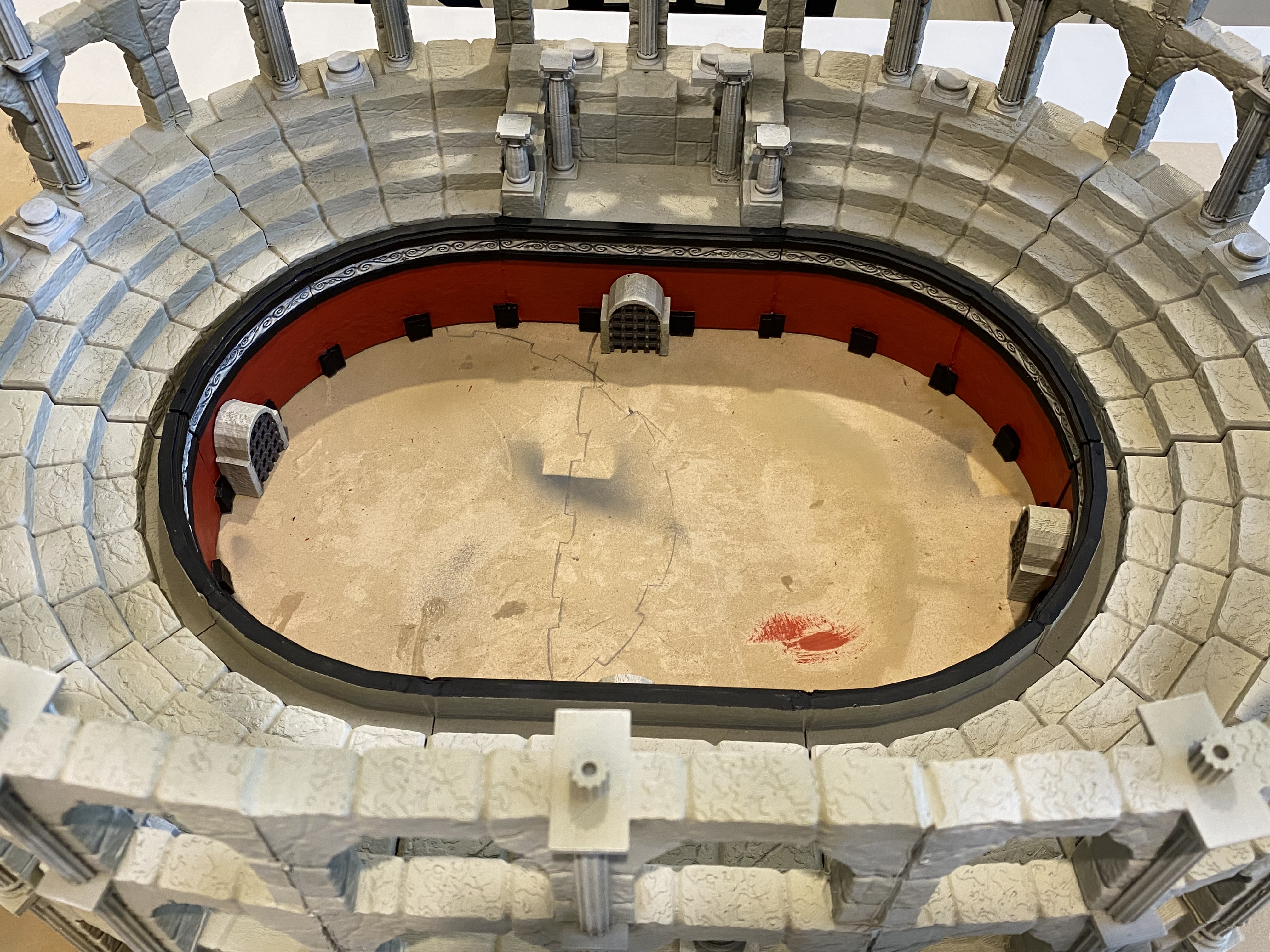
The inside wall of the arena was painted red with a black trim.  Again, I used cheap paints from the local hardware store.

For the many statues that adorn the walls I again used rattle-cans, starting with a blue-grey and working up to white.

I then Painted up 10 Roman Legionnaires to act as security for the Colosseum.  I used colours more akin to Pretorians because I figured that regular legionnaire would not have been used.

I added entranceways so that the combatants could actually enter the arena.

And of course, I couldn’t help but paint up a couple of Gladiators, just to keep me motivated.


Friday, 4 March 2022

Morituri te Salutant. Part 2


Rome wasn't built in a day


For this little project I really wanted to rewrite the rule book (for personal use) with my own version of what I wanted the game to be and bring it up to date.

The original rules were simply walls of black text on white paper and very dated by todays standards.

For my homage to the original rules, I really wanted to do the best I could so adding colour pictures was a good place to start.

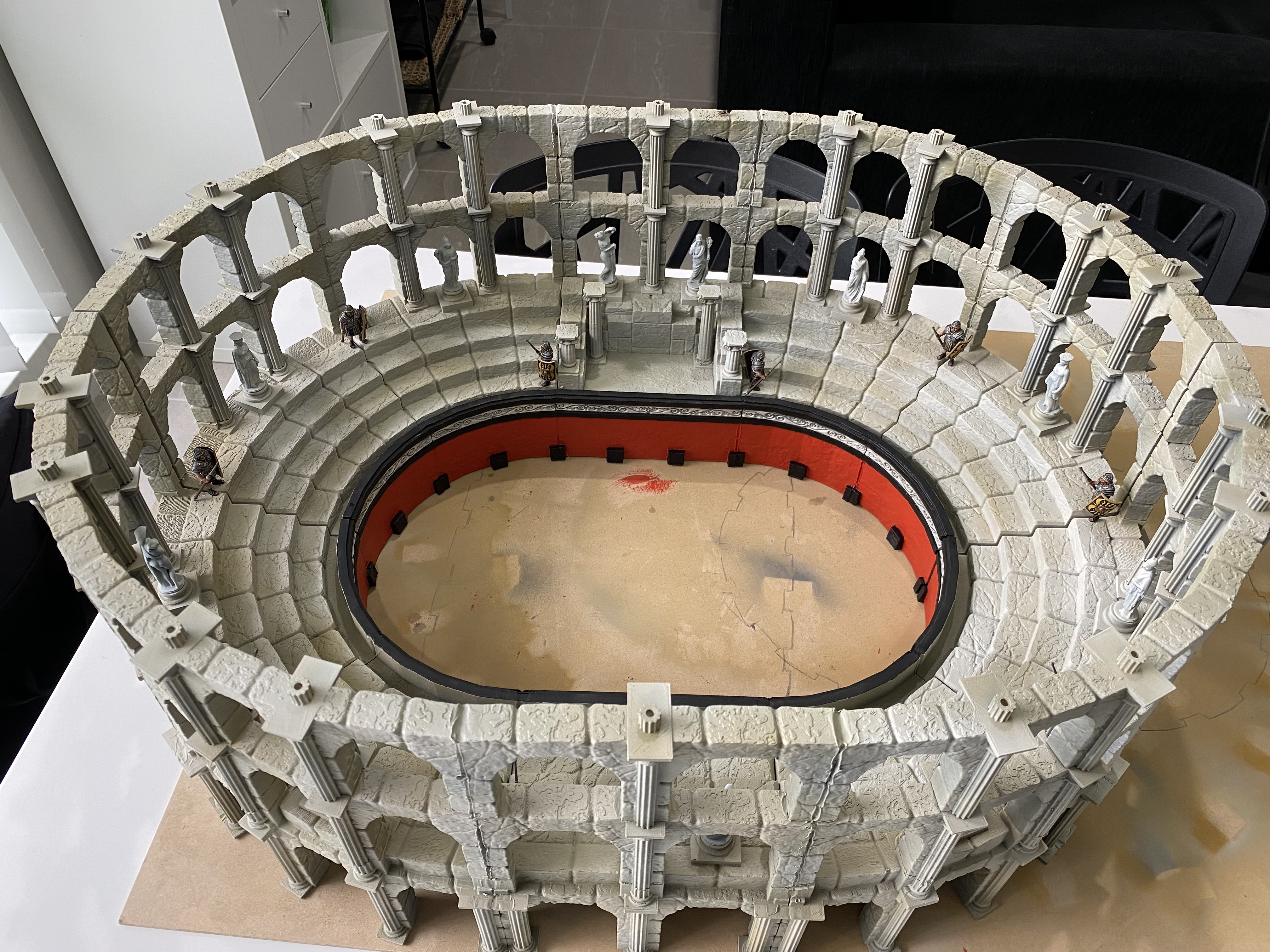
Sure, I could have opted for a simple two-dimensional backdrop for the photos, but I wanted to do something a little grander, something to draw the crowds.

Thankfully the skilful mind of Iain Lovecraft had already created the STL files that would be instrumental in this project.

I set my little Ender 3 Pro to work.


The final structure consists of more than 30 different parts.  I wanted my Colosseum to come apart to allow easier access to the play area that I intend to put inside it.  So extra end sections were printed off to give a nice finish to the structure when it was broken down.


My initial thought was to create it in such a way that it could be split into 3 different pieces, however I finally settled on splitting the Colosseum in half.

With the stonework printed off and welded together I set my Elegoo Saturn to printing off the many Peons, Statues and other ‘miniatures’ I thought I would need for this project.


At 28mm (rather 32mm scale if I’m honest) this is a pretty massive structure.


Tuesday, 1 March 2022

Morituri te Salutant. Part 1


Introduction.


Many years ago, there was a set of Gladiator Skirmish rules simply titled; ‘Gladiator Skirmish Rules’.  They were simply produced and easy to learn and provided fun little games to simulate gladiatorial combat.

The game played on a simple hex grid and the fighting was done in the style of ‘Rock, Paper, Scissor’ where each player would pick an attack and compare it with each other to determine if the attack was easy, medium, or hard to pull off.  This was then converted to a separate table where dice would be rolled and compared with the armour value of the target and the difficulty of the attack to generate a level of wound.  Wounds would accumulate so that three nicks would become a cut, three cuts become a wound and so on.

I really enjoyed that dated set of rules and was looking for something that I could play simple quick games, mainly with the kids, but with friends also.

I wanted to keep the rules as simple as possible whilst keeping the feel of the original rules, or at least how I remember them to be.


This is my homage to those rules.  Some bits will be similar, some bits completely different (mainly because I can’t remember how they were originally) and some bits will be vaguely familiar.


I intend to do my best to create a fun little self-contained project using the little knowledge of our hobby that I have picked up over the years.


Wednesday, 8 December 2021

Macedonian Army Part 11


Mercenaries


The Macedonian army included many mercenaries for these I am just using any figures I like the look of.  For most of them I plan to use Greek figures as I like the look of them, and they have nice shield designs.

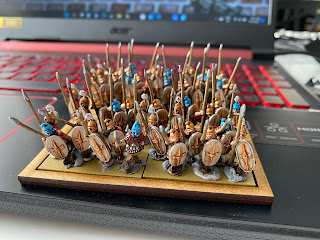
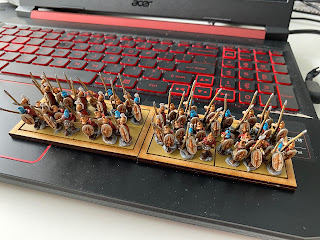
These models, however, are actually Successor Thureophoroi infantry.   I have no idea how I ended up with them but rather let them go to waste they are no substituting as mercenaries.

I have six models to a base, although there are a couple of bases which have seven models for no other reason than because I had spare figures.

Because the footprint of the unit is what matters it doesn't really matter how many figures are in each unit (One of 24 men and one of 26 me) if they look reasonably close order.

They can either be fielded as one large block or my preference is as two smaller blocks.


I still must complete the shields on these, which should really add some colour and help bring these to life.

I am fast running out of models for my Macedonian force and really need to order some more to finish the project.  Maybe something to do once Christmas is out of the way.

Thursday, 18 November 2021

Macedonian Army Part 10


Hypaspists and a start on the left flank


I managed to get some Hypaspists done.   With these I went with 5 models per base to help represent that they fought in a more open order than the Sarissa Phalanx.   They can still form a Phalanx, all be it with shorter spears.


I was not really 100% sure on how to do the shields.   I know they were armed with Greek style large shields, but I am not sure on the shield designs.

I decided to opt for Macedonian Phalanx shield designs on my Hypaspists, mainly because I decided that when I get around to adding Greek Mercenaries, I want them to have Greek shield designs and to stand out from the Macedonian troops.


I have no idea if this is historically correct, but I kind of like the look of them.

The Hypsapists are elite infantry and fill the gap between the Companion Cavalry and the Sarissa Phalanx.


After that I quickly knocked out a unit of Mercenary Cavalry.  They are Greek Cavalry which I figured could form a portion of the Left flank.


To help show them apart from the Companion Cavalry I added a couple of extra colours.

Yellow and Bronze.  The Bronze I used on breast plates and the yellow and I added to some of the clothing and some of the helmets.  I also used red on a few of the helmets too.   None of my Macedonian troops have red or yellow helmets and I figured these little additions would help separate these from the Companion Cavalry.   To add to the effect, I also based these a little different.  From what I could find out these fought in a square formation.

I couldn’t do a square with the footprint size I wanted to use so instead went for a rectangle.  What do you think?


So, my little army is growing and currently looks like this.  I will need to order more figures to complete this army.


Next up I have some Mercenary Infantry to do.   I could do these 4 bases deep too but I kind of like the idea of smaller units to help emphasise how large the Phalanx is.


I still want these smaller units to look like they have a decent number of men in them though.  I am currently looking at 4 bases each of 6 men, so units of 24 models.

From memory these models are Successor Thureophoroi Infantry.  I don't mind and they add a nice difference in appearance to the other infantry.

I have enough figures to do 2 units of 24 men.  I will probably add some command figures to these because I like how it looks with an obvious leader in the units.


Monday, 8 November 2021

Macedonian Army Part 9


Companions


Just a small update as I haven't managed to get too much done due to work commitments.

I've painted up the Companion Cavalry that I have.


I have also added movement trays to my cavalry and ordered some movement trays for my Phalanx.


I did experiment for a while as to how I was going to arrange the models.  It seems that they fought in the wedge formation, and this is about as good I could do without having to have a really large base.


The Wargames Foundry painting guide has an excellent article for painting horses and the colours to use for different breeds.  I highly recommend this book.  It came in invaluable when I painted up a Warhammer Bretonnia army several years ago.


So far, my army looks like this.  I really should add another two trays of Companion Cavalry but that will require me to order even more figures, so that may have to wait for a little while.


Thursday, 28 October 2021

Macedonian Army Part 8


Phalanx


5 blocks of Sarissa armed infantry done, well almost.  I have a standard bearer and a musician left to paint.  All the spear tips to do and of course texture the bases and that will be 320 figures done.


I have decided to stick to 5 units because I have run out of both figures and metal spears.  Also sticking to 5 units should mean my total army frontage will be about 3' long.   This should leave enough room for some manoeuvring and allow for possible flank attacks.


I used shield decals from Little Big Men Studios

They are great little decals although I did find it easier to peel back and then replace the plastic covering before cutting them out.  This seemed to just loosen the bond enough to allow the plastic covering to be easily removed from each tiny individual disk.


I really like the red shields.  I had to paint the rims and rear of the shields and for this used Citadel Evil Sunz Scarlet.  I also added a Hero looking model to the front rank.  I am not sure this would be historically accurate but I liked the model.


For the shield decals with the image of Alexander I used Citadel Xereus Purple to neaten up the edges in the same way I did with the red shields.

I found these particular decals didn’t sit as nicely on the curved shield surface as the other designs did.


So far, I am really enjoying this little journey into Ancients.

I am going to keep plodding along with the Macedonian army despite those Elephants in the India army looking very tempting.

Saturday, 23 October 2021

Macedonian Army Part 7


Formation


This is pretty much what the plan is to work towards.

I know that the table I have is 6' x 4' (approximately 183cm x 122cm) and using 15mm figures I can field a larger army, however I still want to leave enough table space to allow some manoeuvring.  Basically, I want to avoid two lines walking towards each other.

With the India army including chariots, elephants and cavalry I really want them to be able to come into their own and have room to move.  If I am not careful, I could create a situation where the Chariots have no other choice then to perform head on charges.

With each Sarissa Phalanx measuring 8cm across and 8cm deep the centre of my Macedonian army should measure somewhere between 45cm and 54cm across if I leave a 1cm gap between them all.

With that in mind I am envisaging that the entire army will have a facing of roughly twice that.  Approximately 90-108cm or roughly 3 to 4 feet.

Thursday, 21 October 2021

Macedonian Army Part 6


Forming the Centre


I have been steadily smashing through the Sarissa armed troops.  I currently have 3 units done, with the exception of spear tips, basing and shields.

I have enough of the metal spears to do 5 units in total, so 320 men.  I was hoping to do 6 units for a total of 384 men to form the centre of the battle-line.

I guess that will depend on if I can source some more wire spears in the same style as the ones I have already used.


Once I have got the Phalanx finished I am thinking of doing either some Cavalry as a little reward or possibly some Hypaspists.

Hypaspists are an elite selection of  loose formation infantry with shorter spears and larger shields.  A bit more like traditional Greek Hoplites.  They normally formed up on the right on the Phalanx to protect the flank and form a flexible link between the Phalanx and the Companion Cavalry.

Cavalry would probably be Companion Cavalry (Hetairoi) which were the elite heavy cavalry arm of the Macedonian army.  They were an offensive force that made the decisive attack in most of the battles of Alexander the Great.


Spears tips and shields to be completed.

Saturday, 16 October 2021

Macedonian Army Part 5


A Call to Arms


Just a quick comparison showing my initial idea for a complete unit and my final idea.


Spears tips and shields to be completed.